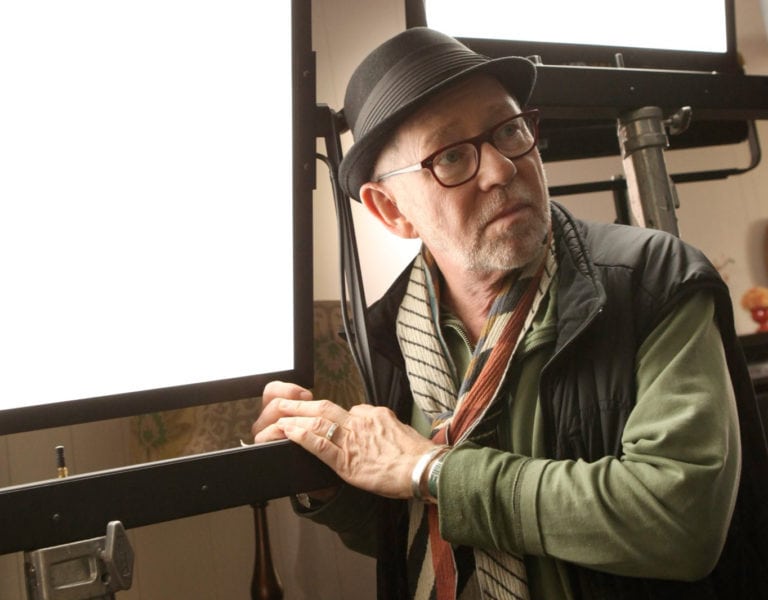

DECEPTIVELY SIMPLE
If the hallmark of a great cinematographer is images that don’t shout louder than the story, then Remi Adefarasin OBE BSC is a master.
Remi Adefarasin OBE BSC’s extraordinary body of work, built on over two decades at the BBC, includes a huge variety of film and TV including Band of Brothers and The Pacific, Onegin, Arabian Nights, About a Boy, Sliding Doors and the multi-award-winning Elizabeth.
Adefarasin himself often describes his photography as “simple” but peers will recognise his art as deceptively so and based on a deep understanding of directorial intent, an economy of movement and intimate knowledge of lighting.
These skills were latent but were brought to the fore on the first feature he shot, the 1980 BBC2 playhouse drama Grown Ups, written and directed by Mike Leigh.
“We didn’t have a grip to help us move the camera around. Certainly, no dolly. Three men on lights and myself and my assistant, Steve Pike,” he explains. “Naturally, it had to be simple static frames and because we only had a couple of sparks we couldn’t get enormous lighting setups. In fact, we had to strap every red head we had to lampposts and hide them just to get a night shot. You must make it work with the equipment at hand and in many ways, you get better results than if you had endless facilities.”
Maybe it’s because he’s a Londoner
Born in London, Adefarasin recalls walking with his mother as a child over Hampstead Heath to visit the Everyman and falling in love with world cinema. “I had a Brownie 127 camera but my mother couldn’t afford to replace the film on a teacher’s salary,” he says.
At 16, he bought a second-hand moped that his grandfather insisted on checking for safety. “At his house I saw some mysterious instruments and he showed me how they worked. It was an enlarger and developing equipment. Using some blackout curtain from WW2, he showed me how to develop and print film. He saw my enthusiasm and gave me an old camera, enlarger, various gadgets and some chemicals. I strapped them to my moped and rode home. The adventure had begun.”

Adefarasin photographed everything including school concerts, sports days and kids in the street. “Their parents gave me some money that I passed on to my grandfather.”
He loved Ken Russell’s films “for their wildness and unpredictability” and longed to work in cinema but found no way of entering the industry. He studied stills photography at Barking Regional College where, on day one, the head of department showed them a pristine Arriflex 16S. “He said we could use it when more experienced. That’s when I decided to make films. I was hooked.”
Using a Zenit Quarz double 8mm camera he began making “stop frame animation and films about milk bottles and bizarre silly things. I knew that I loved film. So, when I heard that Harrow College offered a final year in filmmaking. I applied and was lucky enough to be accepted.”
There can be few better places to learn your trade than in the BBC’s film department at Ealing Studios. Joining straight out of college, Adefarasin’s first summer in the job saw him assisting cinematographer Alan Jonas on The Borderers (1968-70) – a historical drama series set between the frontiers of Scotland and England in the sixteenth century.
Over the next 11 years as a camera assistant, he worked on documentaries “from Belfast to Bangladesh,” music programmes and dramas. “The learning curve was steep. Not just the technical side but also how to get the best out of the team and the contributors.”
The late Brian Tufano BSC (Lifetime Achievement Award recipient, 2020) proved a mentor for the aspiring DP who assisted on 17 plays and many docs. “His love of cinema was refreshing and his lighting style was always authentic and natural,” he says.
Adefarasin remembered that lesson on BBC mini-series Summer’s Lease in Italy (1989) which won Sir John Gielgud an Emmy. Instead of umbrellas they used four parasols for the funeral scene, “a wonderful twist on what people expect to see”.
Photographing The House of Mirth for Terence Davies many years later he recalls how the overcast weather on location by a Scottish loch for a scene set in brilliant sunshine reduced the director to tears.
“He said: ‘We’ve got to come back another time,’ but he wasn’t allowed to because the budget was so tiny and he burst into tears. Terence was unbelievably passionate, unbelievably funny. It was like having Kenneth Williams on set.”
In 1979 Adefarasin was promoted to cinematographer and stayed at the BBC until 1995 as an in-house cinematographer. He worked on Grange Hill, Everyman, American Playhouse, five episodes of Doctor Who, the pilot for Hi-Di-Hi and numerous plays of the week including two more with Leigh, Home Sweet Home (1982) and Four Days in July (1995).

He shot four-part WW2 drama Christabel (1988) for director Adrian Shergold from a Dennis Potter screenplay in Budapest and Austria and Truly Madly Deeply (1990) for Anthony Minghella. Though set in Hampstead, Minghella wanted the crew to work closely as a team so decided to shoot it in Bristol.
Minghella, who also scripted, wanted to shoot his debut feature on 35mm but no one would back him. Not wanting to compromise he decided to cut his losses, shooting on standard 16mm (before S16 arrived) for TV at 25fps. When Samuel Goldwyn won rights to the theatrical release, editor John Stothart had to cut a frame from every scene.
“When you project a 25fps film for cinema at 24fps everything is slowed down by 4%. Pace is lost. So, cutting one frame per cut helps speed it along. Unfortunately, it was shot in the standard 1.37:1 (4:3), so converting to cinema required discarding the top and bottom of the frame.”
Encouraged by the success of Truly Madly Deeply, BBC Films commissioned Memento Mori (1992), which Adefarasin shot for Jack Clayton. It was Clayton’s most critically acclaimed work since his sensational 1959 debut, Room at the Top, and his last before passing and for which the DP was nominated for a BAFTA.
Signature techniques
The rich and varied BBC diet had prepared Adefarasin to make the leap into the freelance world. “A tough decision with three sons and a wife to support but after a slow start I began to get steady employment.”
His first was Channel 4 Films’ Hollow Reed (1996), which sensitively handled issues of domestic violence and sexual orientation. It was directed by “old friend” Angela Pope, with whom he had shot several BBC dramas including romantic crime feature Captives (1994) starring Julia Ormond and Tim Roth.
The breakout hit of 1998 was romantic drama Sliding Doors (1998), directed by Peter Howitt. Featuring a dual narrative and starring Gwyneth Paltrow, the film took $67 million worldwide on a $6 million budget. “Peter specifically asked for the photography to be very simple because he thought that the audience might get confused with understanding which Gwyneth is which if the visuals were too complicated. He just wanted a very simple image. That’s what I do anyway.”
This attracted the eye of Shekhar Kapur, who asked Adefarasin to film historical drama Elizabeth (1998).
“After I got the job, he said he wanted to do lots of shots from a ‘God’s eye’ point of view, looking down at Elizabeth and her situation. When it was obvious he wanted to do that within the body of the film, I suggested to him doing the opening sequence from the same point of view because the beginning of any film prepares the audience for what they are about to see.”

Elizabeth won both the BAFTA and BSC awards for Best Cinematography, but his Oscar nomination made history as the first Black cinematographer recognised in the category. He, Kapur, and stars Cate Blanchett and Geoffrey Rush returned for 2007’s Elizabeth: The Golden Age.
A signature Adefarasin technique is to place black netting (or dyed patterned fabric) in front of a fixture to break up the squareness of the light. “Even reflected in eyeballs you won’t see a square rectangle of an electric light but something more organic.”
Evolved during his drama work with Pope, Adefarasin used this on Elizabeth and later projects, including Band of Brothers, shooting five episodes and earning an Emmy nomination.
On a recent Caribbean assignment with director Hong Khaou for the BAFTA-winning Mr Loverman, they reviewed all eight episodes in detail.
“I’m sure we would have been lost without our prep. We could explore ideas and style without losing time on shoot days.”
Industry inspirations
A pair of films made with Woody Allen (Match Point and Scoop, both set in London and starring Scarlett Johansson) are also “quite simply made,” he says. “Shot on film and without any monitor, Woody stands in the right place, beside the lens. He likes to block out the moves without the actors and then invites the cast to give their interpretation of the scene. He always collaborates.”
It is tempting to draw a line between his affection for the films of Jacques Tati and the unusual number of comic drama on Adefarasin’s CV. Allen aside, they include Paul Weitz (About a Boy; Little Fockers), Johnny English (dir. Howitt) and Ricky Gervais and Stephen Merchant – co-directors on Cemetery Junction. Merchant later sought him out for Fighting with My Family and Gervais for David Brent: Life on the Road.
“I like smart comedy,” he says, “scripts with humour in them, as long as there’s a deeper meaning there for people that speaks about their lives or provides a new way to think about the world or humanity.”

Inspired by “hero” Ossie Morris OBE BSC, Adefarasin refuses to be stuck in one style of filmmaking but says he has a “burnt in sensibility”.
He’d still like to film a psychological thriller and a story set in space. “I’d love to do a Western too. It might not be the archetypal cowboy film in the mid-west but perhaps a road movie.
“I’m still working but when [producers] look online and see that I’m 77 they often choose someone younger because they think they’re faster and that saves them money. People who know me know that I’m fast!”
In accepting the 2026 BSC Lifetime Achievement Award, Adefarasin would like to thank all the wonderful crew who have supported him. They include grips Micky Ellis and John Arnold, gaffers Jim Wilson and Ian Barwick and camera team Simon Finney, Sean Savage, Ben Wilson and Dave Cozens as well as the ARRI team.
“Not to forget my three sons, René, John and Ben, who have often worked beside me. A huge thanks to my mother for letting me pursue my dream and my wife Jaya, who told methe real meaning behind every script and gave endless support.”