
TORTURED SOUL
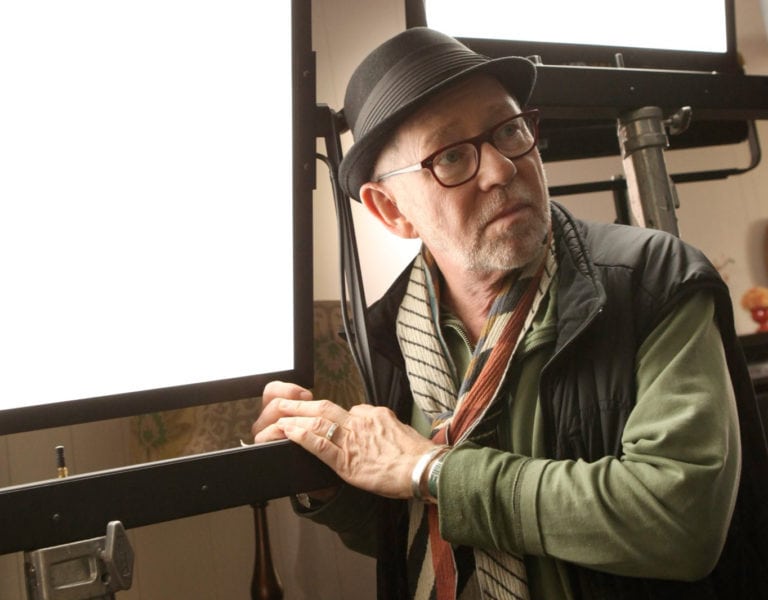
Ben Fordesman BSC revelled in collaboration and creative problem-solving with a kindred spirit when lensing Ronan Day-Lewis’ directorial debut and Daniel Day-Lewis’ welcome return to the screen.
Ben Fordesman BSC was urged to “stop everything” when he was sent the script for Anemone by agent Grant Illes at WME. Spotting the names on the title page and then reading the powerful screenplay—co-written by Ronan Day-Lewis and father Daniel Day-Lewis—the cinematographer “felt the hair stand up” on the back of his neck as he discovered an extraordinary project he could not turn down.
The experience of bringing Anemone to the screen would lead Fordesman (Saint Maud, Love Lies Bleeding) to immerse himself in eight weeks of meticulous preparation, 40 days of inventive and ambitious filmmaking, and one of the most challenging and intimate lighting set-ups he has encountered.
Blending realism with what Fordesman describes as “a metaphysical, almost otherworldly” visual language, Anemone explores the complex ties and legacies of violence between fathers, sons and brothers. Discovering they had a mutual interest in exploring the intimacy and innate conflict of brotherhood, Ronan and Daniel’s narrative revolves around paranoid recluse Ray (played by Daniel Day-Lewis, returning to the screen after an eight-year retirement) and Jem (Sean Bean)—brothers who have been estranged for two decades and both sought redemption in different ways. When Jem arrives unannounced at Ray’s isolated hut in the forest, they attempt to confront and unravel past trauma and tragedy.

“We knew we wanted to keep this story contained so we could do it on a small scale, without too much of the paraphernalia that goes along with filmmaking,” says Daniel Day-Lewis. “We planned to have it take place almost entirely in and around this ramshackle dwelling Ray has made for himself in the woods.”
Ronan—making his feature directorial debut—and Daniel decided early on that the brothers had been involved in a military conflict that affected them in different ways, later settling on incorporating the longstanding Troubles in Ireland into the backstory. The characters of Nessa (Jem’s wife) and son Brian initially existed only in conversation between the brothers, but as Ronan and Daniel “started yearning for their presence” they expanded the story out of the hut, the place ex-soldier Ray has chosen to remove himself from society, and into Nessa and Brian’s lives in Sheffield for select sequences.
Filmmaking future
Through long conversations with Ronan—who is also a gifted painter—Fordesman began constructing a visual world that could be both intimate and expansive. Mixing powerful monologues and portraiture, moments of calm, and turbulent landscapes reflecting the narrative, Anemone aligned with Fordesman’s natural cinematographic instincts. Having had past success working with debut directors, he gravitates toward scripts such as the one Ronan and Daniel penned that allow him to harness his fusion of grounded naturalism and atmospheric intensity.
Ronan was instantly drawn to Fordesman’s visual style, having been impressed by his previous work. “When I saw Love Lies Bleeding, I immediately asked who shot it,” he says. “His sense of colour and way of shaping the light is so special. When I was thinking about a potential DP for Anemone, I kept coming back to him. I felt he would be willing to go in unexpected directions.”
On one hand, Fordesman could see Anemone was “a kitchen-sink-style” drama built around tightly framed two-handers between Ray and Jem or Nessa and Brian having emotional and difficult conversations. The material was at its heart human but also contained elements of vastness and the natural world, incorporating heightened weather sequences and powerful skies, some of which ventured into the realms of fantasy. The pair decided to adopt the widescreen 2.39:1 aspect ratio, feeling it best suited the sprawling landscapes that were weaved into the film.

Despite this being Ronan’s debut feature, Fordesman could see that his painter’s eye and artistic background allowed him to approach the film with creativity, vulnerability and empathy. Having made short films since childhood, Ronan wrote his first feature script at 15 and continued making shorts and music videos through college alongside painting.
His 2018 short film The Sheep and the Wolf won the IFS Film Festival Award for Best Independent Short while he was still in school. Shortly after graduating, he directed a trilogy of music videos for Philip Glass’s “Les Enfants Terribles”.
Daniel Day-Lewis knew his son “was going to be making more films in the future. And I had a certain sadness in knowing that I wouldn’t be working with him at any point,” says the actor. In 2020 he began to exchange ideas with Ronan in the hope of writing a short screenplay together which evolved into a more extensive and personal project.
Painterly quality
Fordesman and Ronan’s shared approach to storytelling formed the basis of the aesthetic language. “He’s such a lovely guy, a really good communicator, really smart and has a strong sensibility to light,” Fordesman says.
Ronan was “one of the most visual directors” Fordesman has worked with. “He had so many good ideas. He grew up in cinema. It’s always a privilege for cinematographers to work with directors who give us so much time to work the image, and during prep I had so much of his time.”

The work of Romantic-era painter J. M. W. Turner which inspired Ronan’s paintings also influenced the film and his desire to incorporate luminous colours, emotionally charged landscapes and seascapes, and menacing depictions of turbulent weather.
“I used to see painting and film as separate, but over time the feelings and images I was drawn to in painting began to bleed into how I was thinking about film,” says the director. “I’m drawn to narrative in painting, but you can explore narrative in such a deeper way in film. To be able to see the images move is so thrilling to me.”
His paintings had a powerful narrative and cinematic quality, becoming a common vocabulary between him and Fordesman during prep and shaping the film’s emotional flow. They returned to Ronan’s artwork on multiple occasions, especially pieces blending cool blues, blue hour crepuscular tones and moody atmospheres.
“Ronan envisioned a perpetual sense of a storm brewing,” says Fordesman. “Every time the sky appeared in Anemone, it needed to feel unreal, heightened, almost ominous and sometimes supernatural.”
Even shooting in the Welsh countryside in summer, Fordesman found ways to capture skies in a way that would make the clouds more dramatic, sometimes subtly embellishing them later in the grade with colourist Gary Curran at Outer Limits.
Two worlds, one emotional thread
Although the filmmakers avoided too many external film references for inspiration, key touchstones that emerged included the “intense compositions and tight framing” of Ingmar Bergman’s Autumn Sonata which became an inspiration for intimate interior scenes between brothers Ray and Jem in the hut. Tight framing forcing the characters into a shared physical and emotional space transitioning to wide shots conveying their decades of separation.
For the hut interiors, Fordesman also studied the claustrophobic framing within confined spaces in Roman Polanski’s Knife in the Water—a “three-hander on a small boat” that mirrored the psychological pressure inside Ray’s hut. “The hut is the heart of the photography of the film; so much happens there and there are so many power dynamics. It’salmost a chess game of power dynamics, so the composition became really important to enforce how they were feeling.”
Inspiration was also found in Australian photographer Trent Parke’s photobook, Crimson Line. The surreal, bold and often industrial landscapes supported the film’s visual goals.
From moments of joy and spontaneous movement on Welsh beaches under stormy skies to claustrophobic confrontations in the flickering light of a remote forest hut, Fordesman’s cinematography mirrored Anemone’s narrative in every scene.
“You have intense conversations between characters in the hut and a power dynamic between Ray and Jem, but we also wanted to create images of alienation and of small spaces surrounded by a vast, still and indifferent landscape,” he explains.
The filmmakers explored the distinct emotional and visual identity of the two primary settings: Ray’s secluded hut (shot in Wales, standing in for Ray’s native Yorkshire) and Nessa and Brian’s Sheffield home. Through haunting and melancholy imagery Fordesman and Ronan wanted to create “a strong sense of stillness and isolation” and composition was often rigid, symmetrical, or tightly compressed, reinforcing the emotional suffocation of the space and the power dynamics between Ray and Jem.
“It has these torture-chamber intensity shots where two characters are crammed together. We wanted that, especially for Ray and Jem.” Their estrangement—“brothers who haven’t seen each other in 20 years”—required a constantly shifting visual and emotional proximity between warmth, distance and claustrophobia.
In contrast, scenes in the Sheffield house were more spacious and grounded. Production designer Chris Oddy and Ronan drew inspiration from Nick Waplington’s documentary photographs of Sheffield in the mid-1990s. Details already present in the chosen location such as a period-appropriate colourful carpet also helped shape the environment.
Fordesman opted for a grounded approach and emotional realism and adopted a unifying rule that the camera should not distract when capturing dialogue scenes. “I wanted an unflinching gaze throughout these long, intense monologues.”
Lighting and logistics
During an initial location scout Oddy discovered an abandoned building deep in Pentraeth Forest in Anglesey that was almost inaccessible but he knew it was the perfect main location hut in which the story would play out. “It was a derelict building constructed entirely of stone in 1840. It was probably occupied until the 1970s but when we found it, it was just stone walls open to the sky and a mud floor,” says Oddy.
Fordesman was impressed by the incredible job Oddy did by “first of all, receiving permission to be able to refurbish the place and then restoring it into a completely habitable shooting location. When he walked into the hut it was important for Daniel [Day-Lewis] to have a place that felt authentic,” says the cinematographer. “Daniel came to prep quite a bit to talk to Chris—sometimes a whole day—about props, about what his character would have realistically scavenged.”
This realism also extended to lighting Ray’s hut as it was off-grid and would use minimal generator power and rely mostly on paraffin Tilley lamps. While this creative constraint presented logistical hurdles for Fordesman and gaffer Jonathan Yates it also became one of the film’s defining aesthetic features.
Working with real paraffin lamps was ruled out since they need endless pressure and refueling maintenance for consistent flame brightness. Instead, to overcome this, Fordesmanand Yates designed a hybrid system comprising some Tilley lamps retrofitted with 150w tungsten bulbs and others which were custom-built with RGB LED clusters, and controlled by desk operator Ed Reilly to generate realistic, subtle flicker. These acted as both practical sources and primary lighting units.
“Tilley lamps are blunt instruments,” Fordesman says. “Small, hard sources which are incredibly easy to move but for delicate close-ups they create harsh shadows. The slightest wrong position just didn’t look photographic. Finding the right position and quality of light from these lamps was a constant challenge.”
In many scenes the camera also pans to explore the room or performs dynamic moves, making hiding film lights nearly impossible. Fordesman and Yates considered using softboxes for night interiors, which would have been an easier option. “After much debate, we decided against this idea as it would have felt studio-lit, instead we leant into the authentic approach,” he adds.
Fordesman acknowledges that the lighting challenges he initially underestimated became the film’s greatest artistic lesson. The film lives in close-ups which convey emotion and internal conflict through every nuance of performance. Finding ways to transform Tilley lamps into expressive, credible, atmospheric film lights required experimentation and perseverance when rethinking techniques.

A replica hut was also meticulously built by Oddy’s team at Aria Film Studios in Anglesey as a backup and used primarily for night interiors, allowing more controlled lighting. Daytime hut scenes on location remained difficult as the tiny windows and thick walls demanded great exterior light output, often using Nanlux Evoke 2400B units bounced into ultra bounces. In Ray’s hut, the lighting carried a sense of menace, reflecting his painful past whereas in Nessa’s home, the visual language was “a little more realistic, a little more kitchen sink”.
Weather as a creative tool
While capturing exterior scenes in Wales was unpredictable due to sudden shifts in wind or downpours, the weather played a central role in the emotion of the storytelling. Beach sequences were the most brutal as unexpectedly fierce waves knocked over Fordesman, risking damaging equipment, and complicating performance continuity. However the childlike and joyous energy captured—with the camera placed in underwater housing—of Ray and Jem playing in the surf was a pivotal emotional beat. Fordesman commends editor Nathan Nugent for creating a sequence from the challenging-to-capture footage.
One of the film’s prominent monologues takes place on the dunes and unfolded in rain, hail and then bright sun, despite the script calling for a consistent overcast atmosphere with a sense of the sun descending. Having contended with the elements, the team relied on the grade to introduce a dynamic warming effect on faces like the sun was going down while using real sunset wide shots to maintain continuity.
Another pivotal and symbolic sequence ventures into fantasy as an apocalyptic hailstorm breaks out, with the hail crafted through VFX designed by Simon Hughes at Union VFX. “The thought of it being created fully by VFX initially terrified me,” says Fordesman. “But Union made it feel fierce and dangerous and it was executed with great realism.”
From stillness to freedom
Having chosen to capture the personal and powerful story with the ARRI Alexa 35, offering the high dynamic range and tonal subtlety required, Fordesman and Ronan explored lens options. While the director initially wanted to shoot on anamorphic glass, Fordesman was hesitant as he felt the hut environment was too tight a space and the practical lamps could create distracting sci-fi-like flares. Extensive testing at Panavision London, which supplied the camera package—complete with naked-flame safety approvals—confirmed the problem and that anamorphic lenses would not suit the genre of production.
Therefore Fordesman chose his trusty Canon K35 spherical lenses as the primary set for their natural aberrations and mysterious quality that was perfect for portraits and close-ups. He then selected Panavision Ultra Speeds and Super Speeds to fill in focal length gaps, mainly using them for wide interior shots. The 29mm Ultra Speed became his wide shot workhorse. As with many of his other productions, Fordesman used no filtration, relying entirely on the beloved characteristics of vintage glass.
Although much of Anemone is still and intimate, the film contains several sequences that required dynamic camera movement. The handheld scenes—particularly dancing or running—were Fordesman’s favourite to shoot.
“Everything else was so meticulously planned, but handheld gave us freedom. You can nail dancing scenes in one or two takes. After an intense, painful monologue, Ray and Jem’s drunken dancing sequence was a release. It needed to be untethered,” he says.

Movement and emotion dictated the camera, with Fordesman operating A camera, working closely with Steadicam operator Jake Whitehouse, who also handled crane work and B camera setups. Tasha Back BSC and David Bird captured second-unit material, with Back shooting the opening shot of the forest and some elements for VFX and Bird handling motorbike sequences and “a beautiful shot of Jem and Ray at sunset”.
Aerial photography, executed by drone operator Ben Platts and Flying Camera Company, was fundamental in conveying the hut’s remoteness. “Ronan wanted to contextualise how secluded this hut was and that it was surrounded by a huge forest. It was a long journey from Sheffield, where Nessa and Jem live, and we had to embellish that a little bit because no matter where you are in the UK, it’s not incredibly remote. But we took some artistic license and to create this feeling the hut was in the middle of nowhere, a great way to do that was through aerial photography,” says Fordesman.
With locations often too windy or wet in which to fly, Fordesman pre-visualised moves using scouting drones and written descriptions and sent the aerial team off to work independently. “They came back with beautiful shots—rock solid, perfect dolly-like moves,” he says.
Emotional force
Outer Limits colourist Gary Curran’s influence and skill helped shape the film’s final look. Ronan had strong views on the shades of green used and spent days fine-tuning the palette with Curran to echo the feel of 1990s Fujifilm stock aesthetics. “I was trying to get the same luminosity in the colours,” says Ronan. “I wanted this specific green that had both a coolness and that luminosity to it.”
Initially resisting the hyper-real greens, Fordesman ultimately embraced their emotional impact. The filmmakers also collaborated with Curran to develop techniques to enhance faces lit by Tilley lamps. In the hut, faces were often half-lit, emerging from darkness and Tilley lamps created small, multiple eye lights. “Sometimes all we needed to do was target the eye lights, sharpen them slightly, and that was enough to see the character without lifting the entire image,” says Fordesman. “They were like eyes hovering out of the screen.”
Contributions of Fordesman’s other collaborators also impacted the final results, such as “cinema warrior” key grip Callum Watt’s “delicate dolly moves and complex crane work—including a difficult shot inspired by Tarkovsky’s Stalker in the Moonlight — which were executed flawlessly”. First AC Russell Kennedy ran operations with military precision amid changing schedules and weather and second AC Jack Ferrari-Plumridge and DIT Joe Lovelock’s flexibility was essential. Fordesman chose to work in Rec. 709 rather than create custom LUTs due to the pace of location work. “Sometimes it was just me grabbing the camera and running near the ocean to capture the action so there wasn’t time for a DIT to keep up and Rec. 709 was the best option,” says Fordesman.
Precision, patience and presence
Working with Day-Lewis—who was making a welcome return to the screen—was an extraordinary experience for Fordesman who describes the renowned method actor as “incredibly generous and patient”. He frequently served as his own stand-in during lighting setups, offering the cinematographer precision in crafting shots.

The actor’s only consistent request during long dialogue-heavy days was to begin on his close-ups as they would carry the most emotional weight. “That’s where most of his energy would be used,” Fordesman says. “It felt high pressure to nail a dynamic shot in a close-up first thing in the morning and everyone needed to be on their A-game. You felt this laser focus from everyone on set every day because the stakes felt higher to capture such an amazing performance.”
Despite the logistical challenges of forest locations, beach storms and hail sequences, lighting faces in the hut using only practicals remained the most demanding. “It seems small, but lighting portraiture authentically, elegantly and under those constraints is what I agonised over.”
But overcoming those obstacles to capture such powerful performances was also one of the most rewarding aspects of the filmmaking journey, as the characters’ faces acted as creative canvases for the filmmakers to use to tell the emotionally charged and personal story.